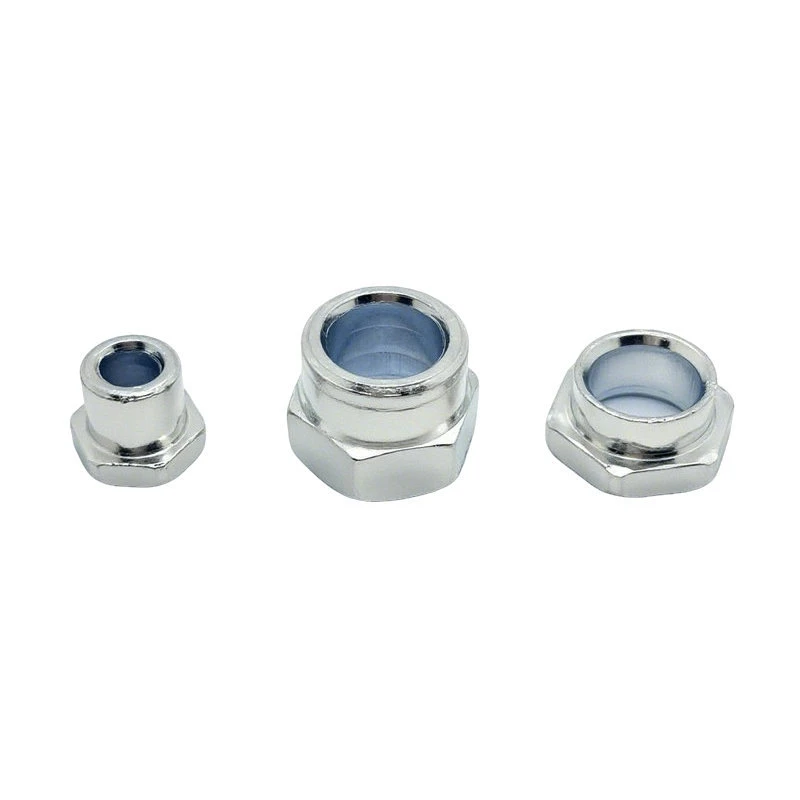
The design of nuts and internally threaded components primarily focuses on connection reliability, load-bearing capacity, and ease of assembly. Its core purpose is to achieve a secure connection between two or more components through the interlocking of internal and external threads. During the design process, the nominal diameter, pitch, thread precision, thickness, and overall dimensions of the nut must be rationally determined based on actual usage requirements to ensure a good fit between the internal thread and the bolt or stud. The nominal diameter and pitch of the thread must be consistent with those of the externally threaded component, and the thread engagement length directly affects the load-bearing capacity of the connection. Insufficient engagement length can easily lead to problems such as internal thread stripping and thread profile damage. Furthermore, an unreasonable nut structural dimension design may also cause localized stress concentration, affecting connection strength. In addition, nuts are subjected to axial tensile force, thread contact pressure, and friction during tightening; therefore, it is necessary to select appropriate materials and strength grades based on the working load and to verify the tensile, compressive, and thread load-bearing capacities of the nut. For connection structures subjected to large loads or long-term vibration, it is also necessary to focus on issues such as thread wear, connection loosening, and fatigue damage to improve the stability of the entire connection system.
Nuts and internally threaded components require selection of appropriate structural forms based on installation space, operating environment, and connection method. Common nuts include hexagonal nuts, square nuts, round nuts, thin nuts, thick nuts, lock nuts, and flange nuts, each with different usage characteristics. For example, hexagonal nuts are widely used in general mechanical equipment due to their simple structure, convenient processing, and easy assembly and disassembly; thin nuts are mainly used in situations with limited installation space or as auxiliary locking; flange nuts expand the contact area through the bottom flange, improving load distribution at the connection; lock nuts increase the anti-loosening capability between threaded pairs through a special structure, making them suitable for working environments with significant vibration. For internally threaded holes machined directly inside mechanical parts, the thread depth, effective engagement length, and bore chamfer must be reasonably determined based on the part material, wall thickness, and stress conditions to avoid connection failure due to insufficient wall thickness or improper thread processing. Material selection should also consider actual working conditions; commonly used materials include carbon steel, alloy steel, and stainless steel. By comprehensively considering structural form, thread parameters, material properties, processing technology and anti-loosening requirements, nuts and internal threaded parts can meet connection strength requirements while possessing good assembly performance, service life and economy.