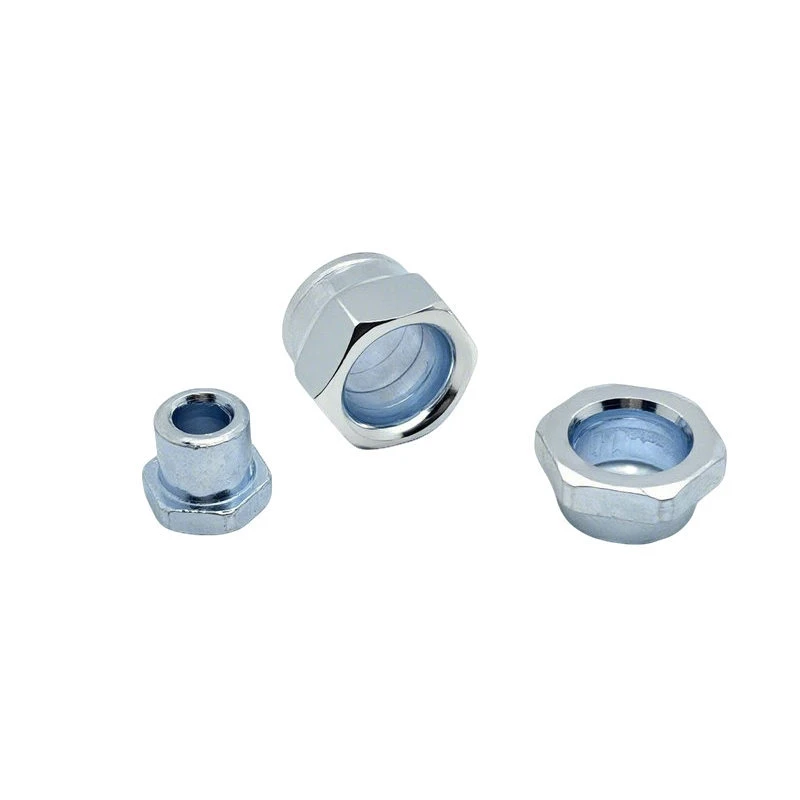
Nuts and internally threaded components, as essential basic connecting parts in the machinery manufacturing industry, still possess significant market potential. Their development trend is closely related to the automotive industry, intelligent manufacturing, new energy industry, aerospace, and high-end equipment manufacturing. As industrial equipment continues to evolve towards automation, precision, and lightweighting, traditional nuts are gradually failing to fully meet the requirements of some high-end mechanical products for connection strength, dimensional accuracy, and service life. The market is placing higher demands on high-strength nuts, precision internally threaded components, and connecting parts with special functions. For example, in the new energy vehicle sector, battery packs, motors, and chassis structures require numerous threaded connectors, demanding high levels of lightweighting, corrosion resistance, and vibration resistance. In the aerospace sector, due to the complex operating environment, the requirements for nut material properties, machining accuracy, and connection reliability are even more stringent. Furthermore, with the development of industries such as wind power generation, photovoltaic equipment, and rail transportation, the demand for high-strength, corrosion-resistant, and long-life nuts for large machinery and outdoor facilities will continue to increase. Therefore, the nut and internally threaded component industry will gradually shift from traditional standard parts production towards high-performance, specialized, and customized products.
The manufacturing of nuts and internally threaded components will place greater emphasis on automation, intelligence, and environmental friendliness. In the future, companies will further adopt advanced technologies such as CNC machining, automated tapping, precision cold heading, and intelligent inspection to improve product dimensional accuracy and production efficiency, while reducing labor costs and material waste. In terms of materials, the application of high-strength alloy steel, stainless steel, and lightweight materials will continue to increase to meet the connection needs of different working environments. In terms of structural design, special nuts with features such as self-locking, anti-loosening, corrosion resistance, and high reliability will receive more attention. Furthermore, digital quality management and online inspection technologies will be gradually applied to the production process, achieving full-process quality control from raw material procurement and processing to finished product inspection. With increasingly stringent environmental requirements, low-pollution surface treatment processes, energy-saving production equipment, and recyclable materials will also become important directions for industry development. Overall, although nuts and internally threaded components are relatively simple basic mechanical parts, their technological level directly affects the connection quality and operational safety of mechanical products. Future industry competition will no longer be limited to product price but will focus more on material performance, processing accuracy, product reliability, and comprehensive manufacturing capabilities. Companies with advanced production technologies and stable quality control capabilities will have a greater competitive advantage.