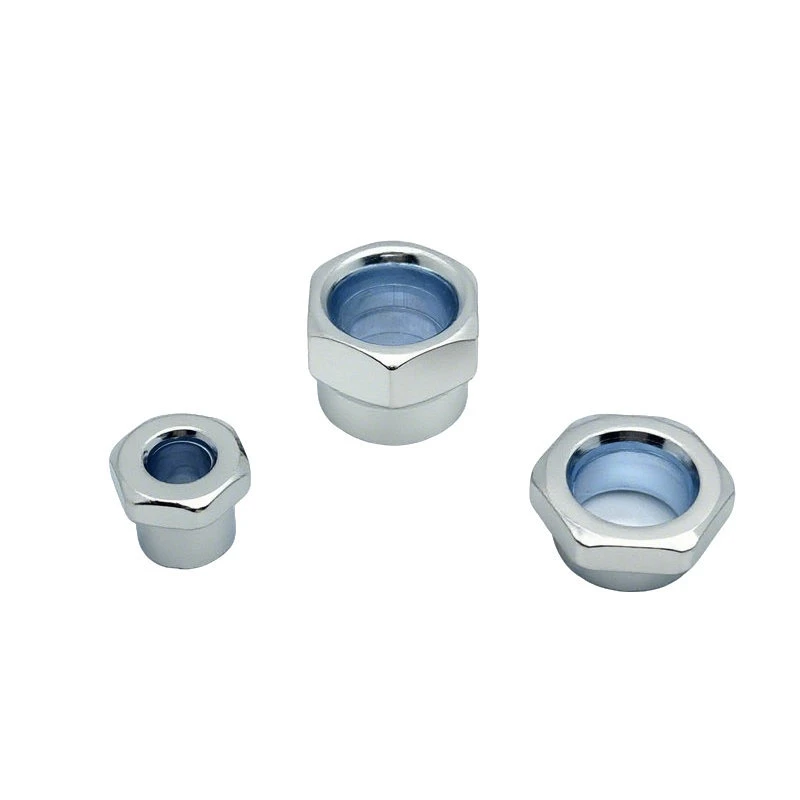
The working principle of nuts and internally threaded components mainly utilizes the helical meshing relationship between internal and external threads to convert rotational motion into axial linear motion, and achieves a tight connection between components through the preload generated by the threaded contact. When a nut is fitted with a bolt or stud, applying a rotational torque to the nut with a wrench causes the nut to move axially along the helix of the bolt, gradually bringing the two parts closer together and pressing them tightly. During tightening, the bolt is subjected to axial tension, while the connected parts are subjected to corresponding compression, thus creating a certain preload at the connection point, keeping the parts in close contact and preventing relative movement under external loads. The thread structure is essentially equivalent to wrapping an inclined helix around the surface of a cylinder, obtaining a large axial force with a relatively small rotational torque, achieving force transmission and amplification. Simultaneously, ordinary triangular threads have a certain self-locking capability; when the thread helix angle is less than the equivalent friction angle, the nut is unlikely to rotate out on its own under axial load without external drive, thus maintaining a relatively stable connection.
Nuts and internally threaded components primarily rely on the contact pressure and friction between the thread flanks to bear the load. When a connector is subjected to external tension, vibration, or impact, the threaded pair transmits the external load to the bolt and the connected parts, maintaining the relative stability of the entire connection structure. If the nut is subjected to reverse rotation, the relative movement between the threads will gradually reduce the preload, which may lead to loosening in severe cases. Therefore, in high-vibration working environments, locking nuts, spring washers, mechanical anti-loosening structures, or thread-locking agents are usually used to improve connection reliability. For internally threaded parts machined directly inside mechanical parts, their working principle is basically the same as that of ordinary nuts, mainly achieving a fixed connection through mutual cooperation with externally threaded parts. The difference is that the internal thread is formed directly inside the part body, which can reduce additional connecting parts and make the structure more compact. In addition, some special internally threaded parts can also cooperate with lead screws to convert rotational motion into precise linear motion, and are used in CNC machine tools, lifting platforms, and automated positioning mechanisms. By rationally designing thread parameters, preload, and anti-loosening structures, stable and reliable connection and motion transmission of nuts and internally threaded parts can be ensured under different working conditions.