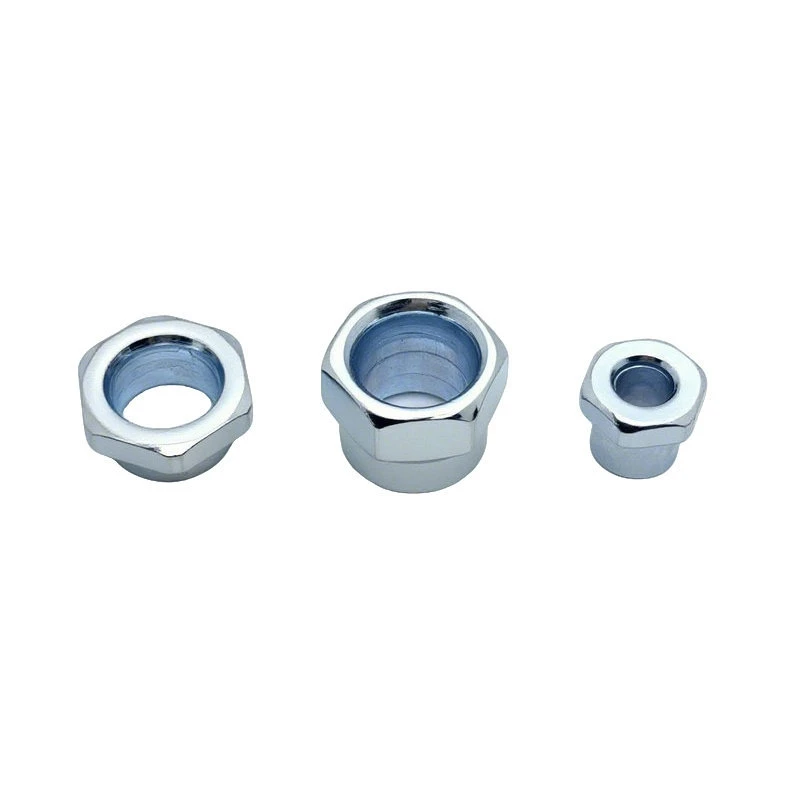
The specifications of nuts and internally threaded parts are mainly determined by parameters such as the nominal diameter of the thread, pitch, nut thickness, dimensions across flats, internal thread precision, and material properties. In mechanical manufacturing, the most common type is the metric standard thread, usually represented by the letter "M" followed by a number, such as M4, M5, M6, M8, M10, M12, M16, M20, and M24, where the number represents the nominal thread diameter in millimeters. Based on the pitch, standard threads can be divided into coarse and fine threads. For example, the standard pitch of an M10 coarse thread is 1.5mm, while the common pitch of an M10 fine thread is 1.25mm or 1.0mm. The external dimensions of the nut are determined by its specific structural form. Common hexagonal nuts mainly include parameters such as the width across flats, thickness, and chamfer dimensions, which must match the corresponding bolt specifications. Furthermore, the precision of the internal thread also affects the fit between the nut and the externally threaded component. A common tolerance zone combination for ordinary metric threads is 6H/6g, where 6H is typically used for internal threads and 6g for external threads, meeting the assembly requirements of most common mechanical connections.
Besides determining the basic dimensions, nuts and internally threaded components should be selected based on the working load, operating environment, and connection method, choosing the appropriate structural type and performance grade. Common nut types include standard hexagonal nuts, thin hexagonal nuts, thick hexagonal nuts, flange nuts, round nuts, lock nuts, and cap nuts. Standard hexagonal nuts are mainly used for general mechanical connections; thin nuts are suitable for installation locations with limited space; thick nuts are suitable for some connection structures requiring a longer thread engagement length; flange nuts increase the contact area; and lock nuts are mainly used in situations requiring increased anti-loosening capability. In terms of materials and performance grades, common steel nut performance grades include 5, 6, 8, 10, and 12, etc., and the specific selection must match the performance grade of the bolt and the connection requirements; stainless steel nuts commonly use material groups such as A2 and A4. For internal threads machined directly inside mechanical parts, the thread diameter, effective depth, and engagement length must be determined reasonably based on the part thickness and material strength to avoid stripping or insufficient connection strength. By appropriately selecting thread specifications, structural dimensions, and material grades, good interchangeability, assembly accuracy, and connection reliability of nuts and internally threaded components can be ensured.