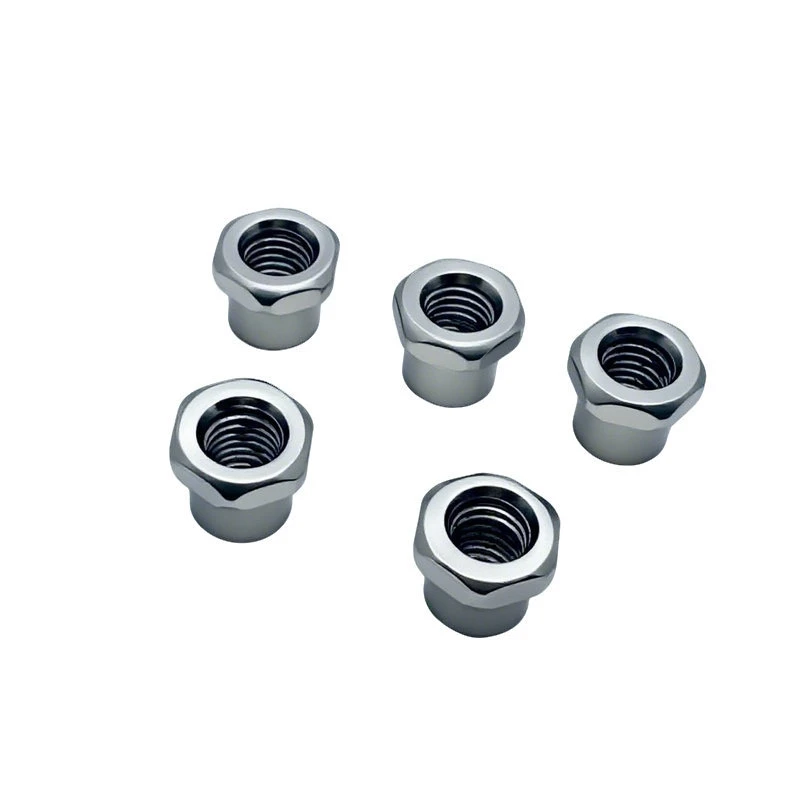
The primary function of nuts and threaded fittings is to fasten, connect, and fix mechanical parts through the interlocking of their internal and external threads, enabling multiple parts to be assembled into a stable overall structure. In mechanical equipment, nuts are typically used in conjunction with bolts or studs. Rotating the nut generates axial preload, creating a clamping effect between the connected parts, thus restricting relative movement and preventing loosening or detachment during operation. Depending on the structural form and usage requirements, nuts can also perform functions such as load transfer, position fixing, and clearance adjustment. For example, hexagonal nuts are mainly used for fastening connections in general mechanical structures; flange nuts improve the stress distribution at the connection point by increasing the contact area; round nuts are commonly used for positioning and fixing shaft parts and bearing structures; and lock nuts increase the anti-loosening capability of threaded connections, reducing the possibility of loosening when the equipment is subjected to vibration and impact. For internally threaded holes machined directly inside mechanical parts, their main function is to provide a connection position for screws or bolts, allowing fasteners to be directly screwed into the part, thereby reducing the use of additional connecting parts and making the overall structure more compact.
Nuts and threaded components also serve functions such as positioning, adjustment, load transmission, and facilitating disassembly and maintenance. In some mechanical transmission structures, nuts can work with lead screws to convert rotary motion into linear motion, and are widely used in CNC machine tools, lifting mechanisms, and precision positioning devices. During bearing installation and transmission component assembly, round nuts can be used to adjust bearing clearance, fix the position of parts on the shaft, and ensure the stable operation of the transmission system. Furthermore, some special nuts also have functions such as preventing loosening, preventing dislodgement, and protecting the connection parts. For example, nylon lock nuts improve connection stability by increasing thread friction resistance, while cap nuts can cover the exposed thread ends, reducing the ingress of dust and moisture, and preventing scratches to operators from exposed threads. For mechanical equipment that requires frequent disassembly, a well-designed nut and threaded structure can improve assembly efficiency and facilitate later inspection, replacement, and maintenance. Therefore, although nuts and threaded components have relatively simple structures, they undertake multiple important functions in mechanical systems, including connection, fixation, positioning, adjustment, and load transmission. Their performance directly affects the assembly quality, operational stability, and service life of the equipment.