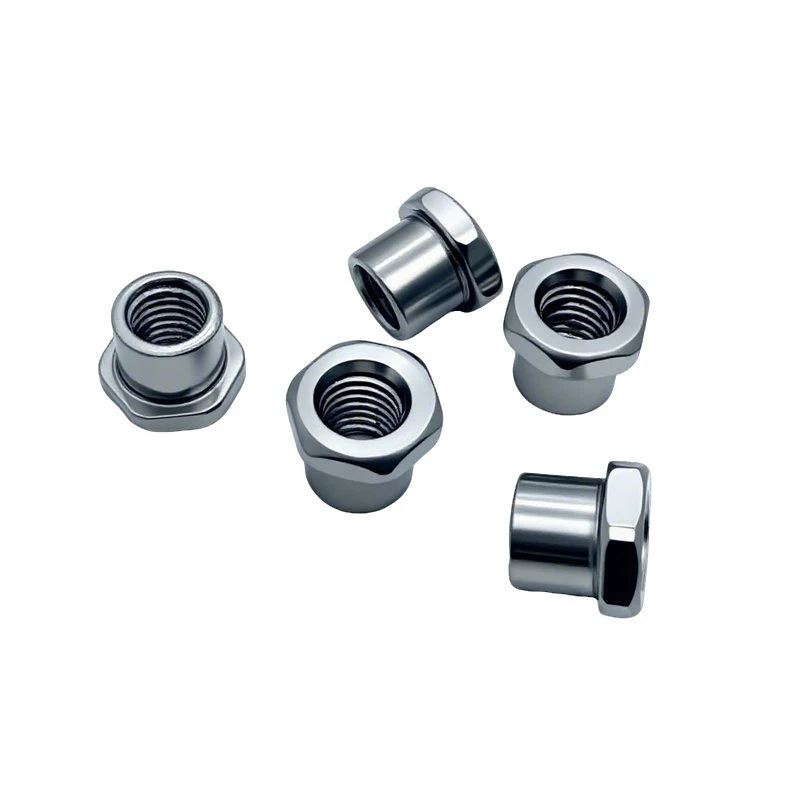
Nuts and threaded components possess advantages such as simple structure, reliable connection, convenient assembly and disassembly, and wide applicability, making them fundamental connecting parts widely used in modern machinery manufacturing. Firstly, nuts achieve a fastening connection through the interlocking of internal and external threads, generating significant axial preload during tightening. This ensures a tight fit between the connected parts, thereby improving the overall structural stability and load-bearing capacity. Compared to permanent connections such as welding and riveting, threaded connections offer better disassembly, facilitating equipment maintenance, parts replacement, and structural adjustments, thus reducing subsequent maintenance costs. Secondly, nuts come in a wide variety of structural forms and specifications, including hexagonal nuts, flange nuts, lock nuts, round nuts, and thin nuts, meeting the installation space and stress requirements of different mechanical structures. Furthermore, the internal thread can be directly machined into the mechanical parts, allowing screws or bolts to connect directly to the parts, reducing the need for additional fasteners and resulting in a more compact overall equipment structure with greater design flexibility.
Nuts and internally threaded components are highly standardized and versatile. Commonly used products have established a relatively complete system of national and industry standards. Qualified standard parts from different manufacturers are generally interchangeable according to their respective standards, facilitating large-scale production, procurement, and assembly. By rationally selecting materials and manufacturing processes, nuts can also possess high mechanical strength, wear resistance, and corrosion resistance. For example, carbon steel and alloy steel nuts are suitable for mechanical structures bearing heavy loads, while stainless steel nuts are suitable for humid or corrosive working environments. Furthermore, some specially structured nuts also have functions such as anti-loosening, positioning, and load adjustment, adapting to connection needs under vibration, impact, and complex working conditions. From a production perspective, nut processing technology is relatively mature, suitable for mass production using automated equipment, offering advantages such as high production efficiency, relatively low manufacturing costs, and a wide range of supply channels. Overall, nuts and internally threaded components play a vital role in automobile manufacturing, machinery equipment, construction engineering, and electronic products due to their excellent connection performance, flexible structural design, and high economic efficiency.